fast-jev-compaction
Replaces the compaction summary with Jev decisions: every tool call and result scored in one request, stale ones dropped, everything kept stays verbatim.
Context compactionSDK or client library
Home / Coding agents
49 entries
Replaces the compaction summary with Jev decisions: every tool call and result scored in one request, stale ones dropped, everything kept stays verbatim.
Routes each task to the cheapest Claude model that can handle it.
Judges every tool result before it enters context, so the window fills slower instead of being cleaned later.
Context-pruning proxy for Claude Code and Codex, with the savings measured rather than claimed.
Rust CLI and hooks that rank installed skills for the next step using live session context, with abstention.
Local proxy that picks model and effort per message and leaves the cached main chat alone.
Per-prompt router over skills, MCP servers, agents, and commands, and it measures whether the injection helped.
A Stop hook that keeps the agent from stopping too early, judged against plain-language rules.
MCP server, embeddable decision model, and an escalate-only plugin that can make the harness stricter but never looser.
Command-line toolkit that coding agents hand judgment-heavy work to, one typed Jev workflow per request.
Agent toolkit whose `/d` command picks the specialist agent, skill, and pipeline with one Jev call, plus an optional Jev auto-compact plugin.
Compaction that asks Jev which tool calls still matter and keeps the rest verbatim, with adapters for Claude Code, Codex, OpenCode, and raw API transcripts.
Trims long Bash output with Jev after the command runs and before the model sees it; short output, errors, and structured formats pass untouched.
Scores your standing rules against each prompt and delivers only the ones that apply, once per session.
Stop hook that blocks an unverified "done": reads the transcript for evidence and, only when files changed with no passing check since, spends one four-question Jev call; fails open on every error path.
Hands the Claude Code, Codex and pi steps that need no text output to Jev, with a typed escalation contract for everything it should not decide.
Picks model, thinking depth, and speed mode for every Codex turn.
A measured tool-call gate plus a `jev_ask` tool for typed answers inside Pi.
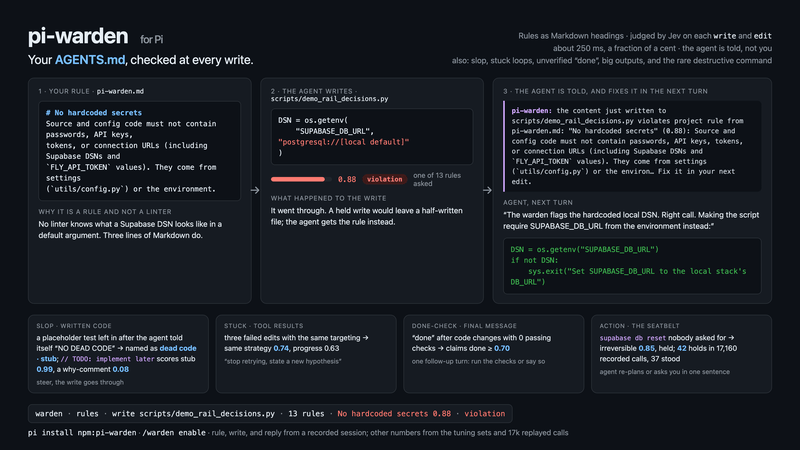
Guardrails that steer instead of interrupt: irreversible calls, off-task calls, stuck loops, unverified done claims, about 250 ms each.
Auto-approves bash, write, and edit calls semantically and fails closed when it cannot decide.
Semantic tool routing and typed decisions as Pi tools.
Automatic model routing for Pi through the Vercel AI Gateway.
The verbatim compaction idea, ported to Pi.
Hybrid harness for Pi: an LLM writes the code, Jev reflexes gate every call as allow, confirm, block, warn, or steer.
Jev as the Pi coding agent's quiet decision layer.
Pi extension exposing Jev judgments as five Pi tools.
Batched evaluation tool, terminal playground, and a typed API for Pi extension authors.
Checks every side-effecting tool call against what you said earlier in the session, so "review only" still holds after compaction.
Checks Pi tool calls, tool outputs, and replies for risky actions and prompt injection, with user approvals, context re-checks, secret scrubbing, and optional task pinning.
Opt-in typed evaluation and semantic search over MCP tool results, behind a per-server data-egress allowlist.
Names the one skill worth loading before the model call; stdlib only, about a tenth of a cent per turn.
Confidence-aware skill routing with an abstain path.
Typed decisions, ranking, verification, and an opt-in tool gate.
Lets Hermes and similar agents ask Jev directly.
Four Hermes tools for atomic checks, routing, and rubric scoring; listed in the Hermes plugin catalog.
Approves, denies, or escalates flagged shell commands before they run; vendor-reported speedups.
Typed tools and probability cards for Agent Zero.
Self-hosted, versioned skills library served over MCP, with Jev recommending which skill to load.
The first MCP server for Jev, and still the most linked.
Classify, score, check, match, and screen, with confidence on every answer.
ACP and MCP adapter that pairs Jev with any LLM for computer use and typed decisions.
Eval-first MCP server: prototype a question, map it over many items, then measure variants against labeled examples with a threshold sweep.
Recursive language model layer for Claude Code, Codex, Gemini, and OpenCode that keeps full sources in a local evaluator; Jev is an optional leaf for reranking, verification, classification, and semantic joins, with budgeted, checkpointed batches.
Skill for writing and improving programs that call Jev.
Finds the fuzzy judgment in a system and turns it into small Choice, Score, and Noul primitives.
Sends a coding agent's closed judgments to Jev instead of the chat model.
Agent-skill directory that can score subjective evaluation criteria with Jev.
Skill for deciding where a typed judgment belongs at all and what stays in code; a companion to the official skill, not a replacement.